

How To Build A Blog Editor Flask
TL;DR: Throughout this article, we are going to use Flask and Python to develop a RESTful API. We will start by creating an endpoint that returns static data (dictionaries). After, we are going to create a class with two specializations and a few endpoints to insert and retrieve instances of these classes. Finally, will take a look on how to run the API on a Docker container. The final code developed throughout this article can be found in this GitHub repository. I hope you enjoy!
"Flask allows Python developers to create lightweight RESTful APIs."

Tweet This
Summary
This article is divided in the following sections:
- Why Python?
- Why Flask?
- Bootstrapping a Flask Application
- Creating a RESTful Endpoint with Flask
- Mapping Models with Python Classes
- Serializing and Deserializing Objects with Marshmallow
- Dockerizing Flask Applications
- Securing Python APIs with Auth0
- Next Steps
Why Python?
Nowadays, choosing Python to develop applications is becoming a very popular choice. As StackOverflow recently analyzed, Python is one of the fastest-growing programming languages, having surpassed even Java on the number of questions asked on the platform. On GitHub, the language shows signs of mass adoption as well, occupying the third position on the number of opened Pull Requests in 2016.
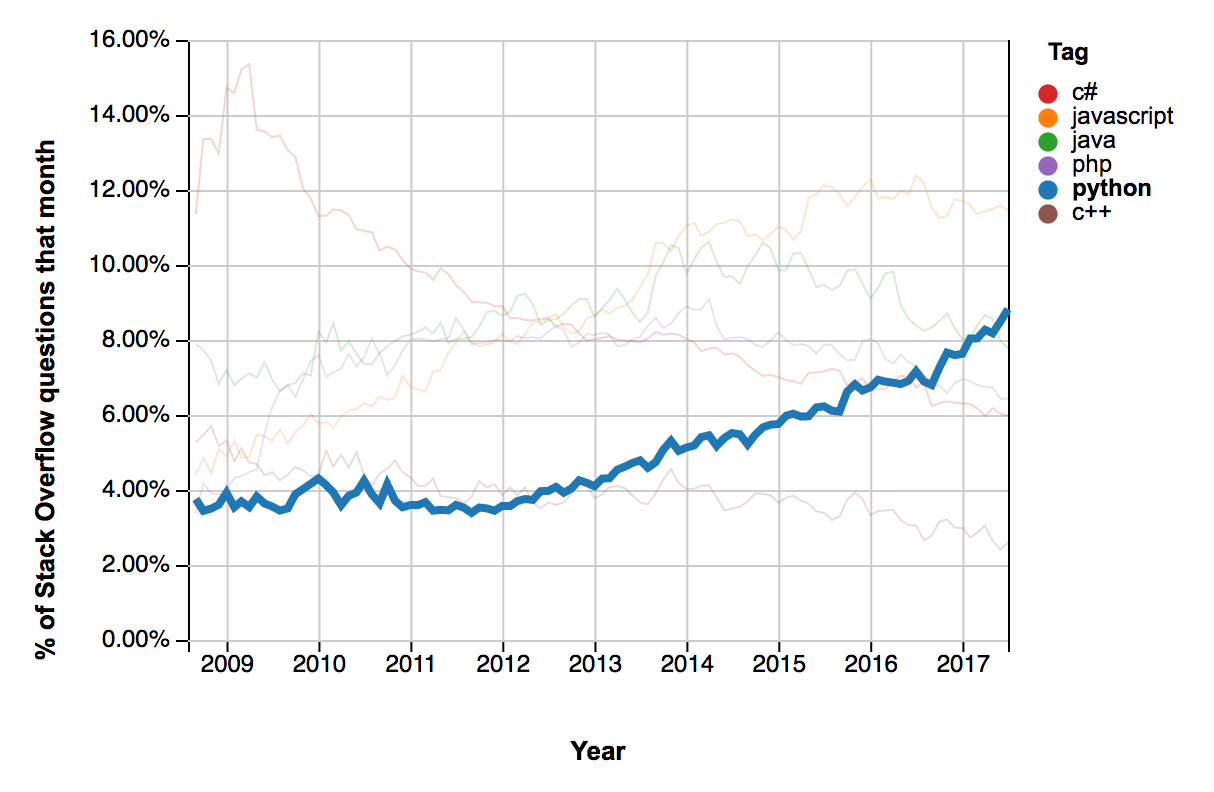
The huge community that is forming around Python is improving every aspect of the language. More and more open source libraries are being released to address many different subjects, like Artificial Intelligence, Machine Learning, and web development. Besides the great support provided by the overall community, the Python Software Foundation also provides excellent documentation where new adopters can learn its essence fast.
Why Flask?
When it comes to web development on Python, there are two frameworks that are widely used: Django and Flask. Django is older, more mature, and a little bit more popular. On GitHub, this framework has around 28k stars, 1.5k contributors, ~170 releases, and more than 11k forks. On StackOverflow, roughly 1.2% of questions asked in a given month are related to Django.
Flask, although less popular, is not far behind. On GitHub, Flask has almost 30k stars, ~445 contributors, ~21 releases, and almost 10k forks. On StackOverflow, up to 0.2% of questions asked in a given month are related to Flask.
Even though Django is older and having a slightly bigger community, Flask has its strengths. From the ground up, Flask was built with scalability and simplicity in mind. Flask applications are known for being lightweight, mainly when compared to their Django counterparts. Flask developers call it a microframework, where micro (as explained here) means that the goal is to keep the core simple but extensible. Flask won't make many decisions for us, such as what database to use or what template engine to choose. Lastly, Flask also has extensive documentation that address everything that developers need to start.
Being lightweight, easy to adopt, well-documented, and popular, Flask is a very good option for developing RESTful APIs.
Bootstrapping a Flask Application
First and foremost, we will need to install some dependencies on our development machine. Basically, what we will need to install is Python 3, Pip (Python Package Index), and Flask. Fortunately, the process of installing these dependencies is quite simple.
Installing Python 3
If we are using some recent version of a popular Linux distribution (like Ubuntu), chances are that we already have Python 3 installed on our computer. If we are running Windows, then we will probably need to install Python 3, as this operating system does not ship with any version at all. Python 2 is installed by default on Mac OS and we have to install Python 3 by ourselves.
After installing Python 3 on our machine, we can check that we have everything set up as expected by running the following command:
python --version # Python 3.6.2 Note that the command above might produce a different output in case we have a different Python version. What is important is that the output begins with Python 3 , and not Python 2 . If we get the latter, we can try issuing python3 --version. If this command produces the correct output, then we have to replace all commands throughout the article.
Installing Pip
[Pip is the recommended tool for installing Python packages. While the official installation page states that pip is already installed if we're using Python 2 >= 2.7 .9 or Python 3 >= 3.4 , installing Python through apt on Ubuntu doesn't install pip. Therefore, let's check if we do need to install pip separately, or if we already have it.
# we might need to change pip by pip3 pip --version # pip 9.0.1 ... (python 3.X) If the command above produces an output similar to pip 9.0 .1 ... (python 3. X ) , then we are good to go. If we get pip 9.0 .1 ... (python 2. X ) , then we can try replacing pip with pip3. If we are unable to find Pip for Python 3 on our machine, we can follow the instructions here to install Pip.
Installing Flask
We already know what Flask is and its capabilities. Therefore, let's focus on installing it on our machine and testing to see if we can get a basic Flask application running. The first step is to use pip to install Flask:
# we might need to replace pip with pip3 pip install Flask After installing the package, we will create a file called hello.py and add five lines of code to it. As we will use this file just to check if Flask was correctly installed, we don't need to nest it in a new directory.
from flask import Flask app = Flask(__name__) @app.route ( "/" ) def hello_world ( ) : return "Hello, World!" These 5 lines of code are everything we need to handle HTTP requests and return a "Hello, World!" message. To run it, we need to export an environment variable called FLASK_APP and then execute flask:
# flask depends on this env variable to find the main file export FLASK_APP =hello.py # now we just need to ask flask to run flask run # * Serving Flask app "hello" # * Running on http://127.0.0.1:5000/ (Press CTRL+C to quit) On Ubuntu, we might need to edit the
$PATHvariable to be able to run flask directly. To do that, let'stouch ~ / .bash_aliasesand thenecho "export PATH=$PATH:~/.local/bin" >> ~ / .bash_aliases.
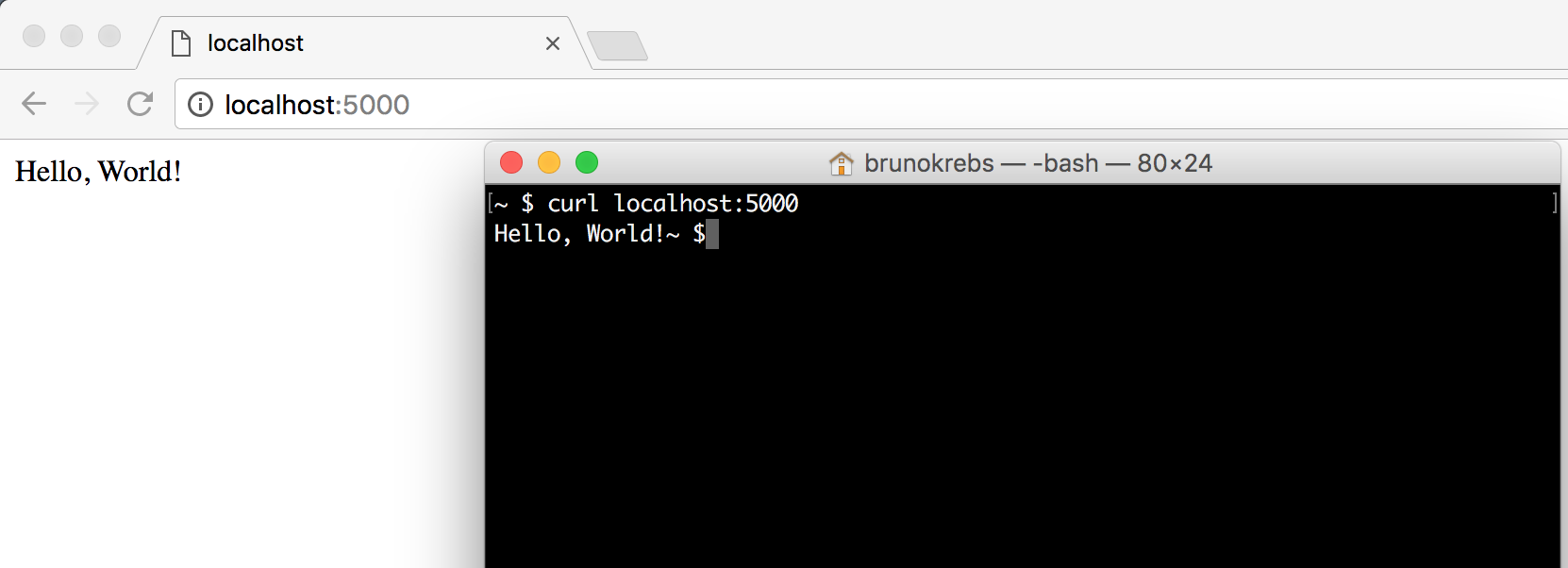
After executing these commands, we can reach our application by opening a browser and navigating to http: / / 127.0.0.1:5000 / or by issuing curl http: / / 127.0.0.1:5000 / .
Virtual Environments (virtualenv)
Although PyPA—the Python Packaging Authority group—recommends pip as the tool for installing Python packages, we will need to use another package to manage our project's dependencies. It's true that pip supports package management through the requirements.txt file, but the tool lacks some features to be used on serious projects running on different production and development machines. Among its issues, the ones that cause the most problems are:
-
pipinstalls packages globally, making it hard to manage multiple versions of the same package on the same machine. -
requirements.txtneed all dependencies and sub-dependencies listed explicitly, a manual process that is tedious and error-prone.
To solve these issues, we are going to use Pipenv. Pipenv is a dependency manager that isolates projects on private environments, allowing packages to be installed per project. If you're familiar with NPM or Ruby's bundler, it's similar in spirit to those tools.
pip install pipenv Now, to start creating a serious Flask application, let's create a new directory that will hold our source code. In this article, we will create Cashman, a small RESTful API that allows users to manage incomes and expenses. Therefore, we will create a directory called cashman-flask-project. After that, we will use pipenv to start our project and manage our dependencies.
# create our project directory and move to it mkdir cashman-flask-project && cd cashman-flask-project # use pipenv to create a Python 3 (--three) virtualenv for our project pipenv --three # install flask a dependency on our project pipenv install flask The second command creates our virtual environment, where all our dependencies will be installed, and the third one will add Flask as our first dependency. If we check our project's directory, we will see that two files are created after executing these commands:
-
Pipfile, a file that contains details about our project, like the Python version that we are using and the packages that our project needs. -
Pipenv.lock,a file that contains exactly what version of each package our project depends on, and its transitive dependencies.
Python Modules
Like other mainstream programming languages, Python also has the concept of modules to enable developers to organize source code according to subjects/functionalities. Similar to Java packages and C# namespaces, modules in Python are files organized in directories that can be imported by other Python scripts. To create a module on a Python application, we just need to create a folder and add an empty file called __init__.py to it.
Let's create our first module on our application. This is going to be our main module, with all our RESTful endpoints. Inside the directory that we created for our application, let's create another one with the same name, cashman. The main cashman-flask-project directory created before will hold metadata about our project, like what dependencies it has, while this new one will be our module with our Python scripts.
# create source code's root mkdir cashman && cd cashman # create an empty __init__.py file touch __init__.py Inside the main module, let's create a script called index.py. In this script, we will define the first endpoint of our application.
from flask import Flask app = Flask(__name__) @app.route ( "/" ) def hello_world ( ) : return "Hello, World!" Just like in the previous example, our application simply returns a "Hello, world!" message. We will start improving it in a second, but first let's create an executable file called bootstrap.sh in the main directory of our application.
# move to the main directory cd .. # create the file touch bootstrap.sh # make it executable chmod +x bootstrap.sh The goal of this file is to facilitate the start up of our application. Its source code will be the following:
#!/bin/sh export FLASK_APP =./cashman/index.py source $(pipenv --venv) /bin/activate flask run -h 0.0.0.0 The first command defines the main script to be executed by Flask, just like we did when we ran the "Hello, world!" application. The second one activates the virtual environment, created by pipenv, so our application can find and execute its dependencies. Lastly, we run our Flask application listening to all interfaces on the computer ( -h 0.0 .0 .0 ).
To check that this script is working correctly, we can execute . /bootstrap.sh now. This will give us a similar result to when we executed the "Hello, world!" application.
# * Serving Flask app "cashman.index" # * Running on http://0.0.0.0:5000/ (Press CTRL+C to quit) Creating a RESTful Endpoint with Flask
Now that we have our application structured, we can start defining some relevant endpoints. As mentioned before, the goal of our application is to help users to manage incomes and expenses. To get our feet wet, we will start by defining two endpoints to handle incomes. Let's replace the contents of the . /cashman/index.py file with the following:
from flask import Flask, jsonify, request app = Flask(__name__) incomes = [ { 'description' : 'salary' , 'amount' : 5000 } ] @app.route ( '/incomes' ) def get_incomes ( ) : return jsonify(incomes) @app.route ( '/incomes' , methods= [ 'POST' ] ) def add_income ( ) : incomes.append(request.get_json( ) ) return '' , 204 Since we are improving our application, we have removed the endpoint that returned "Hello, world!" to users. In its place, we defined an endpoint to handle HTTP GET request to return incomes, and another endpoint to handle HTTP POST requests to add new incomes. These endpoints are annotated with @app.route to define that they listen to requests on the /incomes endpoint. Flask provides a great documentation on what exactly this does.
Right now, we are manipulating incomes as dictionaries to facilitate the process. We will soon create classes to represent incomes and expenses.
To interact with both endpoints that we have created, we can start our application and issue some HTTP requests:
# start the cashman application ./bootstrap.sh & # get incomes curl http://localhost:5000/incomes # add new income curl -X POST -H "Content-Type: application/json" -d '{ "description": "lottery", "amount": 1000.0 }' http://localhost:5000/incomes # check if lottery was added curl localhost:5000/incomes 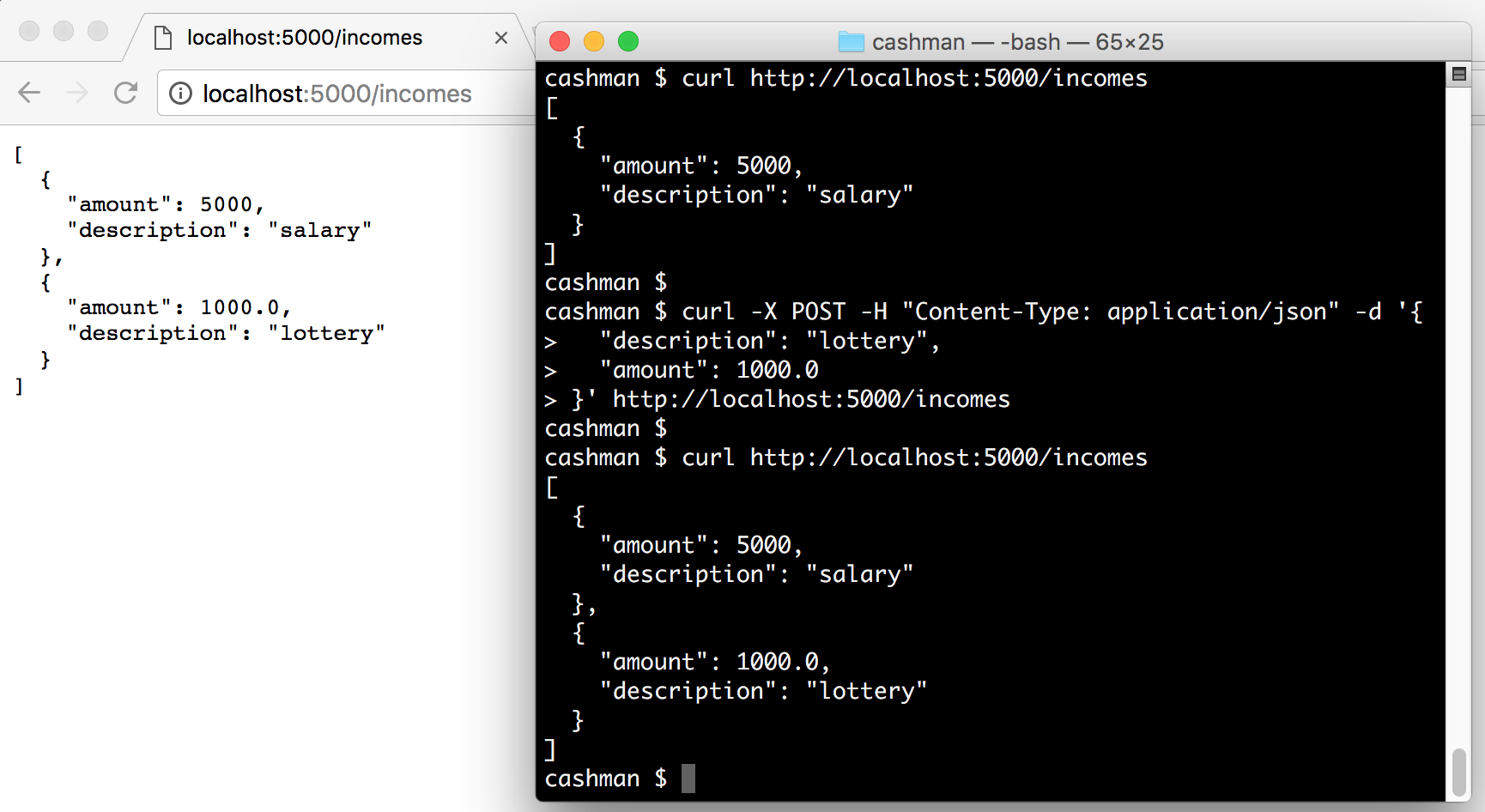
Mapping Models with Python Classes
Using dictionaries in a very simple use case like the one above is enough. However, for more complex applications that deal with different entities and have multiple business rules and validations, we might need to encapsulate our data into Python classes.
To learn the process of mapping entities (like incomes) as classes, we will refactor our application. The first thing that we will do is create a submodule to hold all our entities. Let's create a directory called model inside the cashman module and add an empty file called __init__.py on it.
# create model directory inside the cashman module mkdir -p cashman/model # initialize it as a module touch cashman/model/__init__.py Mapping a Python Superclass
Inside this new module/directory, we will create three classes: Transaction, Income, Expense. The first class will be the base for the two others, and we will call it Transaction. Let's create a file called transaction.py in the model directory with the following code:
import datetime as dt from marshmallow import Schema, fields class Transaction ( ) : def __init__ (self, description, amount, type ) : self.description = description self.amount = amount self.created_at = dt.datetime.now( ) self. type = type def __repr__ (self) : return '<Transaction(name={self.description!r})>' . format (self=self) class TransactionSchema (Schema) : description = fields.Str( ) amount = fields.Number( ) created_at = fields.Date( ) type = fields.Str( ) Note that besides the Transaction class, we also defined a TransactionSchema. We will use the latter to deserialize and serialize instances of Transaction from and to JSON objects. This class inherits from another superclass called Schema that is defined on a package yet to be installed.
# installing marshmallow as a project dependency pipenv install marshmallow Marshmallow is a popular Python package for converting complex datatypes, such as objects, to and from native Python datatypes. Basically, we can use this package to validate, serialize, and deserialize data. We won't dive into validation in this article, as it will be the subject of another one. Though, as mentioned, we will use marshmallow to serialize and deserialize entities through our endpoints.
Mapping Income and Expense as Python Classes
To keep things more organized and meaningful, we won't expose the Transaction class on our endpoints. We will create two specializations to handle the requests: Income and Expense. Let's create a file called income.py inside the model module with the following code:
from marshmallow import post_load from .transaction import Transaction, TransactionSchema from .transaction_type import TransactionType class Income (Transaction) : def __init__ (self, description, amount) : super (Income, self) .__init__(description, amount, TransactionType.INCOME) def __repr__ (self) : return '<Income(name={self.description!r})>' . format (self=self) class IncomeSchema (TransactionSchema) : @post_load def make_income (self, data) : return Income( **data) The only value that this class adds for our application is that it hardcodes the type of the transaction. This type is a Python enumerator, which we still have to create, that will help us filter transactions in the future. Let's create another file, called transaction_type.py, inside model to represent this enumerator:
from enum import Enum class TransactionType (Enum) : INCOME = "INCOME" EXPENSE = "EXPENSE" The code of the enumerator is quite simple. It just defines a class called TransactionType that inherits from Enum and that defines two types: INCOME and EXPENSE .
Lastly, let's create the class that represents expenses. To do that, let's add a new file called expense.py inside model with the following code:
from marshmallow import post_load from .transaction import Transaction, TransactionSchema from .transaction_type import TransactionType class Expense (Transaction) : def __init__ (self, description, amount) : super (Expense, self) .__init__(description, - abs (amount) , TransactionType.EXPENSE) def __repr__ (self) : return '<Expense(name={self.description!r})>' . format (self=self) class ExpenseSchema (TransactionSchema) : @post_load def make_expense (self, data) : return Expense( **data) Similar to Income, this class hardcodes the type of the transaction, but now it passes EXPENSE to the superclass. What makes it different is that it forces the amount passed to be negative. Therefore, no matter if the user sends a positive or a negative value, we will store it as negative to facilitate calculations.
Serializing and Deserializing Objects with Marshmallow
With the Transaction superclass and its specializations properly implemented, we can now enhance our endpoints to deal with these classes. Let's replace . /cashman/index.py contents to:
from flask import Flask, jsonify, request from cashman.model.expense import Expense, ExpenseSchema from cashman.model.income import Income, IncomeSchema from cashman.model.transaction_type import TransactionType app = Flask(__name__) transactions = [ Income( 'Salary', 5000 ), Income( 'Dividends', 200 ), Expense( 'pizza', 50 ), Expense( 'Rock Concert', 100 ) ] @app.route( '/incomes' ) def get_incomes( ): schema = IncomeSchema(many=True) incomes = schema.dump( filter(lambda t: t.type == TransactionType.INCOME, transactions) ) return jsonify(incomes.data) @app.route( '/incomes', methods = [ 'POST' ] ) def add_income( ): income = IncomeSchema( ).load(request.get_json( )) transactions.append(income.data) return "", 204 @app.route( '/expenses' ) def get_expenses( ): schema = ExpenseSchema(many=True) expenses = schema.dump( filter(lambda t: t.type == TransactionType.EXPENSE, transactions) ) return jsonify(expenses.data) @app.route( '/expenses', methods = [ 'POST' ] ) def add_expense( ): expense = ExpenseSchema( ).load(request.get_json( )) transactions.append(expense.data) return "", 204 if __name__ == "__main__" : app.run( ) The new version that we just implemented starts by redefining the incomes variable into a list of Expenses and Incomes, now called transactions. Besides that, we have also changed the implementation of both methods that deal with incomes. For the endpoint used to retrieve incomes, we defined an instance of IncomeSchema to produce JSON representation of incomes. We also used filter to extract incomes only from the transactions list. In the end we send the array of JSON incomes back to users.
The endpoint responsible for accepting new incomes was also refactored. The change on this endpoint was the addition of IncomeSchema to load an instance of Income based on the JSON data sent by the user. As the transactions list deals with instances of Transaction and its subclasses, we just added the new Income in that list.
The other two endpoints responsible for dealing with expenses, get_expenses and add_expense, are almost copies of their income counterparts. The differences are:
- instead of dealing with instances of
Income, we deal with instances ofExpenseto accept new expenses, - and instead of filtering by
TransactionType. INCOMEwe filter byTransactionType. EXPENSE, to send expenses back to the user.
This finishes the implementation of our API. If we run our Flask application now, we will be able to interact with the endpoints, as shown here:
# start the application ./bootstrap.sh & # get expenses curl http://localhost:5000/expenses # add a new expense curl -X POST -H "Content-Type: application/json" -d '{ "amount": 20, "description": "lottery ticket" }' http://localhost:5000/expenses # get incomes curl http://localhost:5000/incomes # add a new income curl -X POST -H "Content-Type: application/json" -d '{ "amount": 300.0, "description": "loan payment" }' http://localhost:5000/incomes Dockerizing Flask Applications
As we are planning to eventually release our API in the cloud, we are going to create a Dockerfile to describe what is needed to run the application on a Docker container. We need to install Docker on our development machine to test and run dockerized instances of our project. Defining a Docker recipe (Dockerfile) will help us run the API on different environments. That is, in the future, we will also install Docker and run our program on environments like production and staging.
Let's create the Dockerfile in the root directory of our project with the following code:
# Using lightweight alpine image FROM python:3.6-alpine # Installing packages RUN apk update RUN pip install --no-cache-dir pipenv # Defining working directory and adding source code WORKDIR /usr/src/app COPY Pipfile Pipfile.lock bootstrap.sh ./ COPY cashman ./cashman # Install API dependencies RUN pipenv install # Start app EXPOSE 5000 ENTRYPOINT [ "/usr/src/app/bootstrap.sh" ] The first item in the recipe defines that we are going to create our Docker container based on the default Python 3 Docker image. After that, we update APK and install pipenv. Having pipenv, we define the working directory that we will use in the image, and we copy the code needed to bootstrap and run the application. In the fourth step, we use pipenv to install all our Python dependencies. Lastly, we define that our image will communicate through port 5000 and that this image, when executed, needs to run the bootstrap.sh script to start Flask.
To create and run a Docker container based on the Dockerfile that we created, we can execute the following commands:
# build the image docker build -t cashman . # run a new docker container named cashman docker run --name cashman \ -d -p 5000:5000 \ cashman # fetch incomes from the dockerized instance curl http://localhost:5000/incomes/ The Dockerfile is simple but effective, and using it is similarly easy. With these commands and this Dockerfile, we can run as many instances of our API as we need with no trouble. It's just a matter of defining another port on the host, or even another host.
Securing Python APIs with Auth0
Securing Python APIs with Auth0 is very easy and brings a lot of great features to the table. With Auth0, we only have to write a few lines of code to get:
- A solid identity management solution, including single sign-on
- User management
- Support for social identity providers (like Facebook, GitHub, Twitter, etc.)
- Enterprise identity providers (Active Directory, LDAP, SAML, etc.)
- Our own database of users
For example, to secure Python APIs written with Flask, we can simply create a requires_auth decorator:
# Format error response and append status code def get_token_auth_header ( ) : """Obtains the access token from the Authorization Header """ auth = request.headers.get( "Authorization" , None ) if not auth: raise AuthError( { "code" : "authorization_header_missing" , "description" : "Authorization header is expected" } , 401 ) parts = auth.split( ) if parts[ 0 ] .lower( ) != "bearer" : raise AuthError( { "code" : "invalid_header" , "description" : "Authorization header must start with" " Bearer" } , 401 ) elif len (parts) == 1 : raise AuthError( { "code" : "invalid_header" , "description" : "Token not found" } , 401 ) elif len (parts) > 2 : raise AuthError( { "code" : "invalid_header" , "description" : "Authorization header must be" " Bearer token" } , 401 ) token = parts[ 1 ] return token def requires_auth (f) : """Determines if the access token is valid """ @wraps (f) def decorated ( *args, **kwargs) : token = get_token_auth_header( ) jsonurl = urlopen( "https://" +AUTH0_DOMAIN+ "/.well-known/jwks.json" ) jwks = json.loads(jsonurl.read( ) ) unverified_header = jwt.get_unverified_header(token) rsa_key = { } for key in jwks[ "keys" ] : if key[ "kid" ] == unverified_header[ "kid" ] : rsa_key = { "kty" : key[ "kty" ] , "kid" : key[ "kid" ] , "use" : key[ "use" ] , "n" : key[ "n" ] , "e" : key[ "e" ] } if rsa_key: try : payload = jwt.decode( token, rsa_key, algorithms=ALGORITHMS, audience=API_AUDIENCE, issuer= "https://" +AUTH0_DOMAIN+ "/" ) except jwt.ExpiredSignatureError: raise AuthError( { "code" : "token_expired" , "description" : "token is expired" } , 401 ) except jwt.JWTClaimsError: raise AuthError( { "code" : "invalid_claims" , "description" : "incorrect claims," "please check the audience and issuer" } , 401 ) except Exception: raise AuthError( { "code" : "invalid_header" , "description" : "Unable to parse authentication" " token." } , 400 ) _app_ctx_stack.top.current_user = payload return f( *args, **kwargs) raise AuthError( { "code" : "invalid_header" , "description" : "Unable to find appropriate key" } , 400 ) return decorated Then use it in our endpoints:
# Controllers API # This doesn't need authentication @app.route ( "/ping" ) @cross_origin (headers= [ 'Content-Type' , 'Authorization' ] ) def ping ( ) : return "All good. You don't need to be authenticated to call this" # This does need authentication @app.route ( "/secured/ping" ) @cross_origin (headers= [ 'Content-Type' , 'Authorization' ] ) @requires_auth def secured_ping ( ) : return "All good. You only get this message if you're authenticated" To learn more about securing Python APIs with Auth0, take a look at this tutorial. Alongside with tutorials for backend technologies (like Python, Java, and PHP), the Auth0 Docs webpage also provides tutorials for Mobile/Native apps and Single-Page applications.
Next Steps
In this article we learned about the basic components needed to develop a well structured Flask application. We took a look on how to use pipenv to manage the dependencies of our API. After that, we installed and used Flask and Marshmallow to create endpoints capable of receiving and sending JSON responses. In the end we also took a look at how to dockerize the API, which will facilitate the release of the application to the cloud.
Although well structured, our API is not that useful yet. Among the things that we can improve, we are going to cover the following topics in the next article:
- Database persistence with SQLAlchemy
- Global Exception Handling
- Internationalization (i18n)
- Security with JWTs
Stay tuned!
How To Build A Blog Editor Flask
Source: https://auth0.com/blog/developing-restful-apis-with-python-and-flask/
Posted by: defeosherarcon.blogspot.com
0 Response to "How To Build A Blog Editor Flask"
Post a Comment